A check dress shirt sits in a useful middle place. It is smarter than a plain casual shirt, because the pattern shows you thought about the outfit, but it is less formal than a plain white dress shirt, so it works for offices that are not suit-and-tie every day, for dinners, and for smart weekends. The trick with mens check dress shirts is scale and contrast: a check that is too large or too high-contrast stops looking like a dress shirt and starts looking like a lumberjack shirt, while a check that is too faint disappears and you might as well have worn a solid.

Start with the job the shirt has to do. If you need it for work, choose a small, low-contrast check in blue, grey, or a muted tone. If you need it for a dinner or a weekend, you can go larger and warmer, with rust, green, or brown in the pattern. One shirt cannot do both jobs perfectly, and trying to force it usually means it does neither well. Buy the work version first, then add a bolder one for off-duty days.
The checks, in plain language
Gingham is the check most men recognise first: even squares formed by overlapping stripes of one colour and white. A small blue gingham reads as neat and classic. A large red gingham reads as picnic and casual. For a dress shirt, small gingham is the safe, versatile choice. Large gingham is a casual shirt, however well it is made.
Tattersall is a check of thin lines in two colours, usually on a light background, forming a grid with small squares inside larger ones. It looks refined and slightly country, and it pairs well with tweed, wool trousers, and smarter casual outfits. A green-and-brown tattersall on cream is a good example. It is patterned, but the lines are thin, so it does not shout.
Windowpane, as with blazers, uses wide lines to form large open squares. On a dress shirt, windowpane needs care. A subtle windowpane in a tone close to the shirt colour can look smart. A bold, high-contrast windowpane can overwhelm a tie, a jacket, and the rest of the outfit. Keep windowpane dress shirts for occasions where the shirt is the main piece, not for days when you need to wear a suit and tie over it.
Graph check, also called mini-check, is a very small grid, almost like graph paper. From a distance it reads as texture rather than pattern. It is the easiest check to wear to a formal office, because it behaves like a solid but has more interest up close. If your office is conservative, a graph check in blue or grey is the check to buy.
Buffalo check, with large blocks of two colours, is not a dress shirt pattern in the usual sense. It is a casual, outdoor pattern. It can look great with jeans and boots, but it does not belong under a suit for work. Knowing where buffalo check stops is as useful as knowing where dress checks start.
Colour and contrast: the two-second rule
Hold the shirt at arm’s length. If the check is clear and bold from that distance, it is a high-contrast shirt. If it softens into a near-solid, it is low-contrast. Low-contrast checks are more formal and more forgiving. They pair with suits, ties, and patterned blazers more easily, because they do not compete. High-contrast checks are more casual and need plain partners: plain trousers, a plain jacket or no jacket, and plain shoes.
Colour follows the same logic. Blue checks are the most versatile, because blue suits most skin tones and pairs with navy, grey, charcoal, and brown. Grey checks are quiet and smart, and they work well for men who find blue too common. White-based checks with a thin coloured line are fresh and work well in warmer months. Warm checks in rust, olive, or brown suit autumn and winter, and they pair best with brown shoes and darker trousers.
Skin tone matters, but not in the complicated way some guides suggest. Stand in daylight wearing the shirt and look at your face, not the shirt. Does the shirt make you look washed out, or does it sit comfortably against your skin? A check with a strong white base can wash out very pale skin, while a very dark check can be harsh on darker skin if the contrast is extreme. The fix is usually to choose a softer version of the same colour, not a different colour altogether. If a bright blue check looks harsh, try a muted blue check. If a dark check looks heavy, try the same pattern on a lighter background.

Fit: the dress shirt tests
A dress shirt must fit in ways a casual shirt can hide. Start with the collar. Buttoned, it should feel snug but allow two fingers between the collar and your neck. If you cannot fit two fingers, it is too tight and will feel worse by the end of the day. If you can fit three or four fingers, it is too loose and will gape when you wear a tie or a jacket.
Next, the shoulders. The shoulder seam should sit at the end of your shoulder bone. A seam that droops down the arm makes the whole shirt look borrowed, and a seam that pulls inward makes the check lines bend over the shoulder, which is obvious with a pattern.
Check the chest and waist with the shirt tucked in and buttoned. The fabric should lie flat, without pulling into an X at the buttons and without billowing out at the sides when you tuck it in. A slim fit is not the same as a tight fit. Slim means the shirt follows your shape with a little room to move. Tight means the buttons strain and the check distorts. With checks, distortion is easy to see, because straight lines bend where the shirt is too tight.
Sleeve length is simple to check: with your arms at your sides, the cuff should reach the wrist bone and cover the wrist when you wear a jacket. When you bend your arm, the cuff should not ride up far above the wrist. Cuffs that are too tight will be uncomfortable with a watch, and cuffs that are too loose will slide over your hands under a jacket.
Finally, the shirt tail. A dress shirt needs enough length to stay tucked in when you sit, stand, and reach. A shirt that pops out every time you sit down is either too short or too slim at the waist. Test it by sitting down, standing up, and raising your arms. If the shirt stays tucked, the length is right.
Collars, cuffs, and fabric
For a check dress shirt, a spread collar or a semi-spread collar is the most versatile. It frames a tie well and looks balanced open-collar as well. A button-down collar is more casual and works well with an unstructured blazer or on its own, but it is less formal under a suit. A very narrow, fashion collar can look dated fast, and it does not suit a check pattern well, because the small collar fights the pattern for attention. Choose a collar size that matches your face and neck, not the trend of the season.
Cuffs should be simple. A single-button barrel cuff is right for most check dress shirts. A French cuff, which needs cufflinks, is too formal for most checks and will look overdressed. If you wear a check shirt with a suit for a formal event, a plain shirt is usually the better choice anyway.
Fabric changes how a check looks and feels. Cotton is the standard for dress shirts, and a cotton with a smooth, slightly crisp finish holds a check pattern cleanly. Oxford cloth has a visible texture that softens a check and makes it more casual. It is excellent for smart-casual check shirts, but less suited to a formal office. Flannel checks are warm and soft, but they are casual shirts, not dress shirts, however neat the pattern. Linen checks breathe well in summer but wrinkle fast, so they suit relaxed settings, not long office days.
Check the fabric in daylight before you buy. Some checks look crisp in the shop and muddy outside, because the colours are duller than they seemed under bright lights. Others look quiet in the shop and surprisingly bold outside. Daylight is the honest test, and it takes ten seconds.
For help choosing outerwear length to pair with a shirt, see the coat length guide for women.
How to style mens check dress shirts without clashing
The rule is the same as for any patterned shirt: one pattern leads, the rest support. If the shirt is checked, the suit or blazer should be plain, the tie should be plain or very subtly textured, and the trousers should be plain. A plain navy suit with a small blue check shirt and a plain burgundy tie is a classic combination that works in most offices. A plain charcoal suit with a grey graph-check shirt and no tie works for a smart dinner.
If you want to wear a patterned blazer with a check shirt, the scales must be clearly different. A small-check shirt with a large-check blazer can work, because the eye reads them as different levels of pattern. A medium-check shirt with a medium-check blazer will clash, even if the colours match, because the patterns compete at the same scale. When in doubt, wear a plain blazer. It is never the wrong choice with a check shirt.
Without a jacket, a check dress shirt needs good trousers and shoes to stay smart. Dark navy or charcoal trousers, or dark, clean chinos, keep it dressy. Light chinos make it more casual, which is fine for weekends but not for a formal office. Shoes should be leather, in brown or black, and clean. Sneakers with a check dress shirt can work in a very casual office, but they push the outfit from smart to casual, so be deliberate about it.
Tuck or untuck? A dress shirt is designed to be tucked in. If the shirt has a straight hem and is short enough to look finished untucked, it is probably a casual shirt, not a dress shirt. For work, dinners, and any occasion where you want to look polished, tuck it in and wear a belt that matches your shoes. For a relaxed weekend, an untucked check shirt with a curved hem can work, but it should be a deliberate casual choice, not a dress shirt that has come untucked by accident.
For office outfit ideas, see how to style a blouse for the office.

Four ready outfits
Office, conservative: small blue graph-check shirt, plain navy suit, plain dark tie, black leather shoes. The check adds interest without breaking office rules.
Office, relaxed: blue gingham shirt, plain grey trousers, navy unstructured blazer, brown leather shoes, no tie. The blazer is plain, so the shirt can lead.
Dinner: rust or muted red check shirt, charcoal trousers, dark brown shoes, no jacket or a plain dark blazer if the restaurant is smart. Keep the colours warm and the pattern medium, not loud.
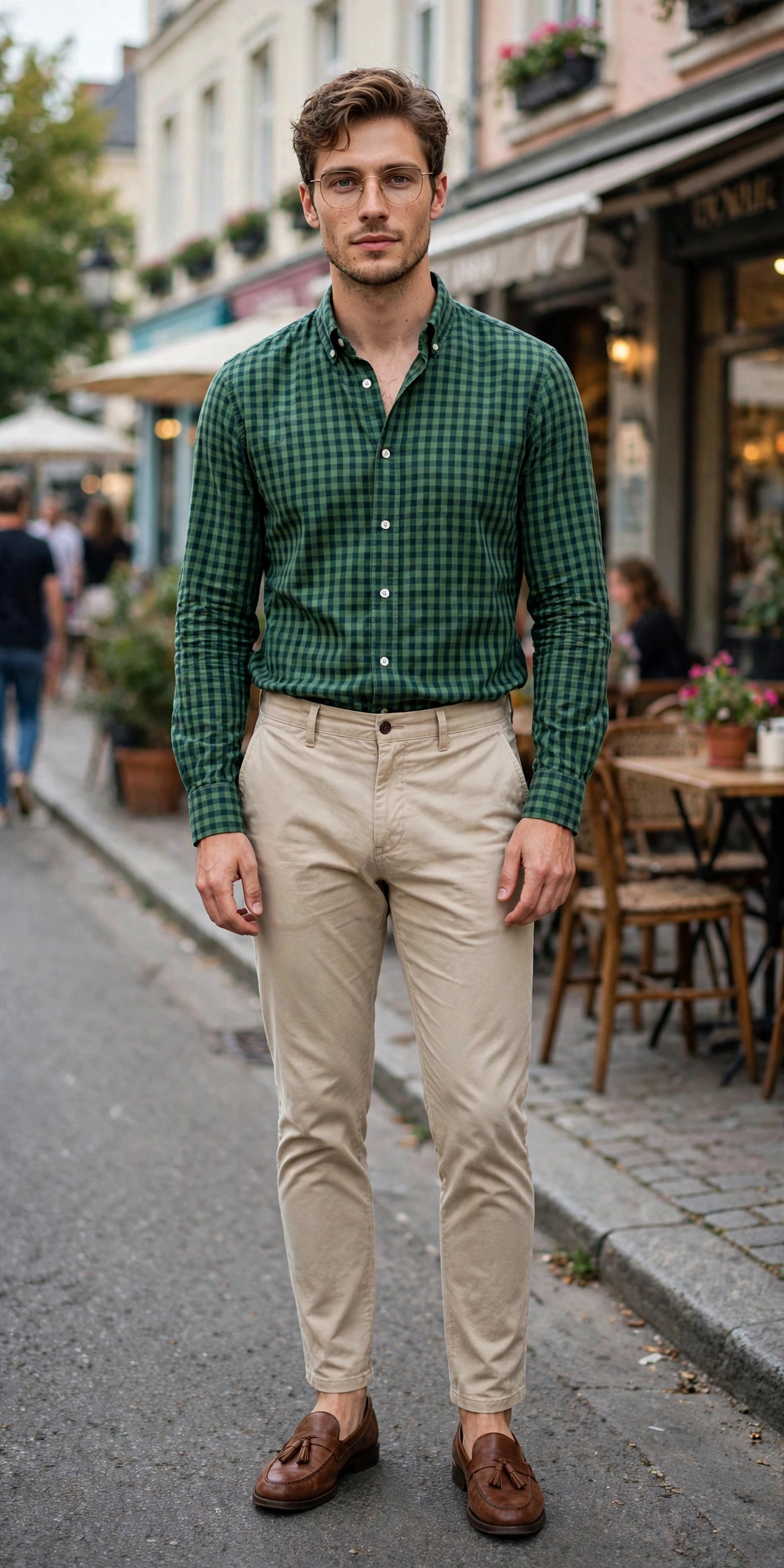
Weekend smart: green tattersall shirt, beige or olive chinos, brown suede shoes, sleeves rolled to the forearm. Rolling the sleeves softens a dress shirt and makes it weekend-ready, but roll them neatly to the same point on both arms, not bunched at the elbow.
If-X-then-Y decisions
If your office is formal, then choose a graph check or a small gingham in blue or grey, wear it with a plain suit, and keep the tie plain.
If your office is casual, then choose a medium gingham or tattersall, wear it with plain chinos or dark trousers, and skip the tie.
If you are wearing a patterned blazer, then choose a check shirt in a clearly smaller scale, or swap to a plain shirt. Do not match pattern scales.
If the check is bold and high-contrast, then wear plain dark trousers, plain shoes, and no other pattern. Let the shirt be the statement.
If you are shorter, then choose a smaller check. A large check can break up your frame and make you look shorter. If you are taller or broader, a medium check suits you, but a very small check may disappear, so do not go too tiny.
If the shirt will be worn under a sweater, then choose a check that is visible at the collar and cuffs only, such as a small check with a light background. A bold check under a sweater is wasted, because only the collar shows, and a bold collar with a plain sweater can look mismatched.
Care, ironing, and keeping checks crisp
Check shirts show wrinkles more than plain shirts, because the lines bend where the fabric creases. Iron or steam a check shirt with care, pressing along the lines rather than across them where you can. A shirt that is pressed flat but with bent check lines at the creases will look untidy up close. If you use a steamer, hang the shirt and let the weight of the fabric pull it straight.
Wash check shirts inside out, in cool or warm water as the label directs, and avoid over-drying. High heat fades colours and can make a check look washed out over time. Line drying or low-heat tumble drying preserves the pattern longer. If a check shirt fades unevenly, it is usually because of heat or harsh detergent, not because the pattern was poor.
Store dress shirts on hangers, buttoned at the top button, so the collar holds its shape. Folding a check dress shirt for a long time creates creases that cut across the pattern and are hard to remove. If you travel with one, roll it rather than folding it flat, and hang it as soon as you arrive. A quick steam in the bathroom after a hot shower can rescue a travel-creased shirt, but it will not fix a shirt that has been folded for weeks.
Mistakes to avoid
Wearing a check shirt with check trousers, a check tie, and a check blazer is the fastest way to look busy. One check per outfit is the rule, with the shirt usually being that check.
Wearing a large, high-contrast check to a formal meeting is a second mistake. It draws attention to the shirt instead of to you, and in a formal setting that works against you. Save bold checks for casual days.
Buying a check shirt that is too tight because it looks slim on the hanger is a third mistake. Checks show tightness instantly, as bent lines and pulling buttons. A shirt with a little room looks smarter than a tight shirt that distorts its own pattern.
Ignoring the collar fit is a fourth mistake. A collar that is too tight will be uncomfortable all day, and a collar that is too loose will look sloppy under a jacket. Collar fit is not a detail to guess. Measure it, or try the two-finger test every time.
Finally, treating a casual flannel check as a dress shirt is a mistake of category, not taste. Flannel checks are excellent shirts, but they are not dress shirts. Wearing one to a formal office does not make the office more relaxed. It makes the outfit look mismatched. Keep flannel for weekends and casual days, and keep cotton checks for dress occasions.
Mens check dress shirts work because they add personality without adding risk, when the scale, contrast, and fit are right. Choose a small or medium check in a colour you already wear, make sure the collar, shoulders, and waist fit without distortion, and keep everything else plain. Do the daylight test, check the shirt in a mirror from a few feet away, and trust the simple rule: if the pattern looks calm, the outfit will look calm too.
Frequently asked questions
Are check dress shirts formal enough for the office?
Small, low-contrast checks in blue or grey are formal enough for most offices, especially with a plain suit and a plain tie. Large, high-contrast checks are better for casual offices, dinners, and weekends. If your office is very formal, a plain white or light blue shirt is still the safest choice for important meetings.
What tie should I wear with a check shirt?
A plain tie in a colour pulled from the shirt or from your suit, such as navy, burgundy, or charcoal, is the safest choice. A tie with a very small, subtle texture can work, but a striped or checked tie will usually clash with a check shirt. When in doubt, wear a plain tie or no tie.
Can I wear a check dress shirt with a patterned blazer?
Yes, only if the scales are clearly different, for example a small-check shirt with a large-check blazer. If both patterns are medium scale, they will compete. A plain blazer is always safe with a check shirt and is the better choice if you are unsure.
Should a check dress shirt be tucked in?
Yes, for work, dinners, and formal occasions. A dress shirt is designed to be tucked in, and it needs enough tail length to stay tucked when you sit and stand. For relaxed weekends, an untucked check shirt with a curved hem can work, but that is a casual shirt style, not a dress shirt worn untucked by accident.
How do I choose a check size for my frame?
Smaller checks suit shorter frames, because they do not break up the body into large blocks. Medium checks suit most frames and are the most versatile. Larger checks suit taller or broader frames, but they are more casual and need plainer partners. If you are unsure, choose a small or medium check first.
How do I wash a check dress shirt without fading it?
Wash it inside out in cool or warm water, avoid high heat, and do not over-dry it. Line drying or low-heat tumble drying preserves colour and pattern longer. Iron or steam along the pattern lines where possible, and store the shirt on a hanger with the top button done up so the collar keeps its shape.