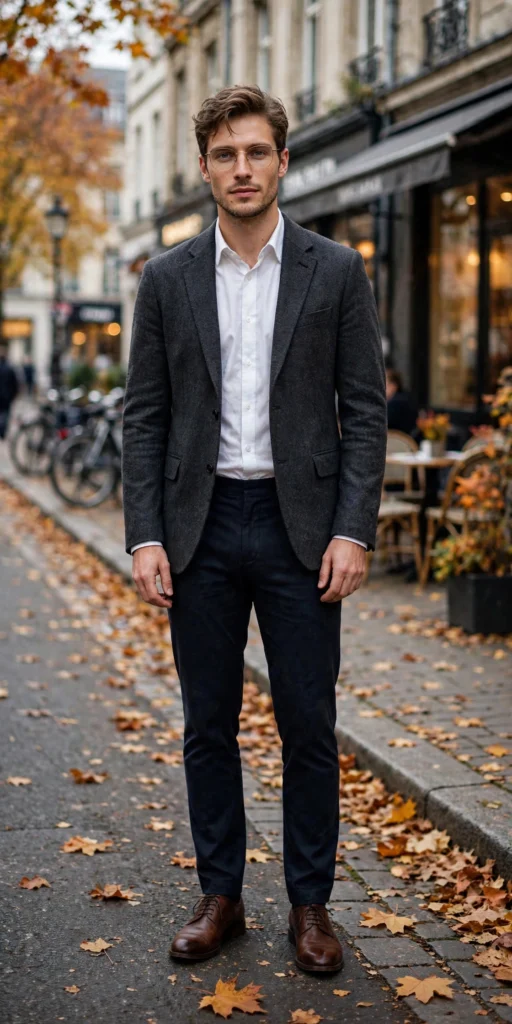
A plaid blazer works when the pattern reads as texture from a few steps away, not as a shout. That is the whole test for mens plaid blazers: stand back, look in a mirror, and ask whether you notice the man first or the jacket first. If the jacket wins, something is too large, too bright, or too busy. If you win, the pattern is doing its job, which is to add interest to an otherwise plain outfit without turning you into a billboard.
Most men go wrong in one of three ways. They pick a check so large it breaks the body into blocks. They pair a loud plaid with a patterned shirt, a patterned tie, and patterned trousers, so nothing rests. Or they buy a blazer that fits in the shoulders but balloons at the waist, which makes the pattern look even bigger. Fix those three things and plaid becomes easy, not risky.
Start with scale. A small check, sometimes called a micro-check or a Prince of Wales pattern with fine lines, behaves almost like a solid from conversation distance. It is the safest first plaid. A medium check, where each square is roughly the width of a thumb, is the classic middle ground and suits most casual offices, dinners, and weekend outings. A large windowpane, where wide lines form big open squares, is the boldest option. It can look superb on a tall frame with plain everything else, and it can overwhelm a shorter frame or a busy room. If you are buying your first plaid blazer, choose small or medium scale. Leave windowpane for the second one, when you already know how much pattern you like wearing.
Colour works the same way. A plaid built from grey, navy, brown, and a thin line of cream or rust is forgiving. Those colours already live in most wardrobes, so the blazer pairs with shirts and trousers you own. A plaid with bright red, yellow, or electric blue lines is harder. It is not forbidden, but it narrows every other choice. You will need plain dark trousers, a plain shirt, and plain shoes, and you will still draw the eye. Ask yourself honestly how often you want that. For most men, the answer is once in a while, which means the bright plaid should not be the only plaid you own.
How to tell a good plaid blazer in the shop
Hold the blazer up and check pattern matching before you try it on. At the shoulder seam, the lines should meet or come close to meeting. At the front, where the blazer buttons, the check should line up reasonably across the opening. At the pockets, a well-made blazer often matches the pattern on the pocket flap to the body, or at least keeps it close. Perfect matching everywhere is rare at lower prices, and small mismatches are normal. Large, obvious jumps, where a bold line suddenly stops and restarts an inch away, are a sign of careless cutting. That matters more with plaid than with a solid, because the eye follows the lines.
Next, check the cloth. Hold it to the light and feel the weight. A blazer that is too thin will wrinkle fast and show every pull. A blazer that is too stiff will stand away from the body and make the check look boxy. The middle is a cloth that drapes when you hold it by the shoulders and falls back into shape when you let go. Wool and wool blends do this well for cooler months. Cotton and linen blends do it for warmer months, but they wrinkle more, so expect a more relaxed look. If the label lists a high share of shiny synthetic fibre, be cautious. Shine plus plaid is a loud combination, and it often looks cheaper than it costs.
Look at the lining and the buttonholes. You do not need to be an expert to spot care. A lining that hangs straight, without bunching at the hem, and buttonholes that are cleanly finished, tell you the maker paid attention. Turn the blazer inside out at the hem if you can. Loose threads everywhere are not a deal-breaker on their own, but combined with poor pattern matching, they are a reason to keep looking.
Fit checks that matter more with pattern
Plaid punishes bad fit because the lines show every pull and fold. Use these checks in front of a mirror, with the blazer buttoned.
First, the shoulder seam should sit at the end of your shoulder bone, not drooping down the arm and not pulling inward. If the shoulder is too wide, the check will sag and the whole jacket will look borrowed. If it is too narrow, the lines will stretch and bend over the shoulder point.
Second, button the top button only, as you would for a two-button blazer, and look at the front. The fabric should lie flat. If it pulls into an X shape at the button, the blazer is too tight across the stomach or chest. If it hangs open in a wide V with no shape at all, it may be too large or too straight-cut for you. A little movement when you breathe is fine. A permanent X is not.
Third, check the sleeve. With your arms at your sides, the sleeve should end near the wrist bone and show about a finger’s width of shirt cuff. If the check pattern at the cuff looks bunched, the sleeve is too long. If your shirt cuff disappears completely, the sleeve is too short or the shirt is too short. Either way, fix it before you judge the pattern, because sleeve length changes how the whole blazer reads.
Fourth, check the length. An unstructured rule that works for most men is that the blazer should cover your seat and end roughly where your thumb joint sits when your arms hang naturally. Shorter blazers look modern and casual, longer blazers look formal and traditional. With plaid, a very short length can make a large check look like a cropped box, so if you like a short cut, keep the check small.
Fifth, move. Sit down, reach forward as if shaking hands, and raise your arms halfway. A good blazer lets you do that without feeling locked across the back. Plaid shows strain lines across the back faster than a solid does, so if you see sharp diagonal pulls when you move, try a size up or a cut with a little stretch.
What to wear underneath: keep one pattern only
The simplest rule for mens plaid blazers is one pattern per outfit. The blazer is the pattern. Everything else stays plain. That means a plain white, light blue, black, or cream shirt, plain trousers, and plain shoes. A plain knit polo or a fine turtleneck also works in cooler weather, as long as it has no stripes, logos, or texture that competes. A thin crew-neck sweater under an unstructured plaid blazer can look smart, but a chunky knit will bulk up the chest and distort the check.
If you want to add a tie, keep it plain or nearly plain. A solid navy, burgundy, dark green, or charcoal tie lets the plaid breathe. A tie with its own small pattern can work if the scale is clearly different from the blazer check, for example a tiny dot tie with a large windowpane, but this is an advanced move. When in doubt, skip the tie. An open-collar shirt with a plaid blazer already looks finished for most offices and dinners.
Pocket squares follow the same logic. A plain white linen square, folded flat, is the safe finish. A patterned silk square in a colour pulled from the blazer can work, but it must not repeat the plaid. If the square and the blazer fight for attention, take the square out. A blazer does not need a pocket square to look complete.
Trousers, shoes, and the rest of the outfit
Trousers should be darker than the lightest colour in the plaid, or close to the darkest colour in it. Navy trousers work with grey and brown plaids. Charcoal trousers work with almost everything. Dark jeans work with casual plaids, especially unstructured blazers with soft shoulders, but they must be dark, clean, and straight, not faded, ripped, or heavily washed. Light trousers with a dark plaid can work in summer, but the contrast is high, so keep the shirt and shoes simple to balance it.
Shoes should be plain leather in brown, dark brown, or black. Suede works for casual outfits and softens a sharp check. Avoid shoes with heavy broguing, bright colours, or busy patterns when the blazer is already patterned. A belt should match the shoes in tone, not exactly in shade, but close enough that the eye does not stop at the waist. If you wear dark jeans, a simple leather belt in brown or black is enough.
Socks are a small detail that ruins more plaid outfits than men expect. Bright novelty socks with a plaid blazer turn a smart outfit into a joke outfit. Choose socks that match the trousers or the shoes. If you want a little colour, pull a muted tone from the blazer, such as dark rust or olive, but keep it dark and plain.
Four outfits with mens plaid blazers that always work
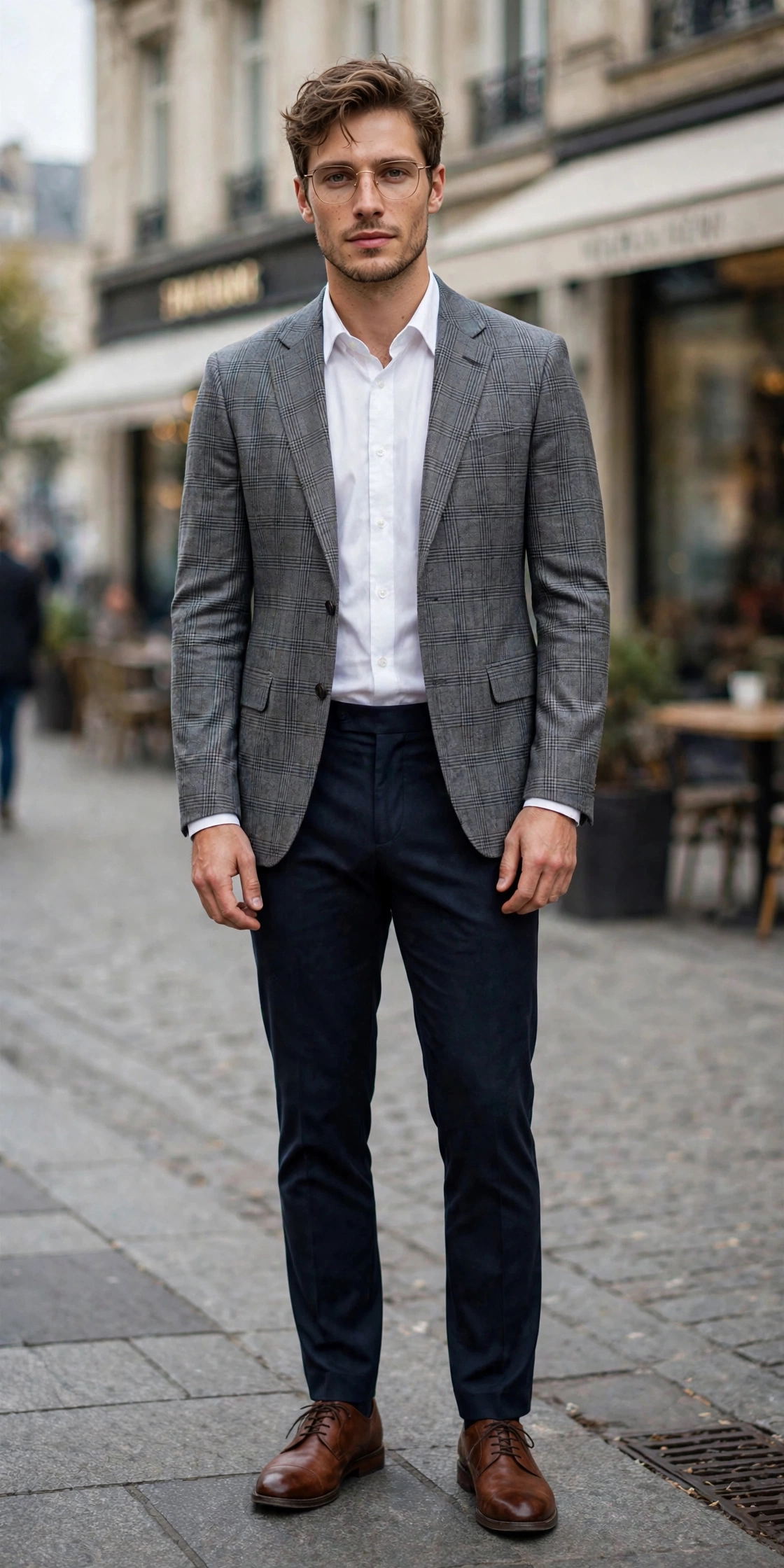
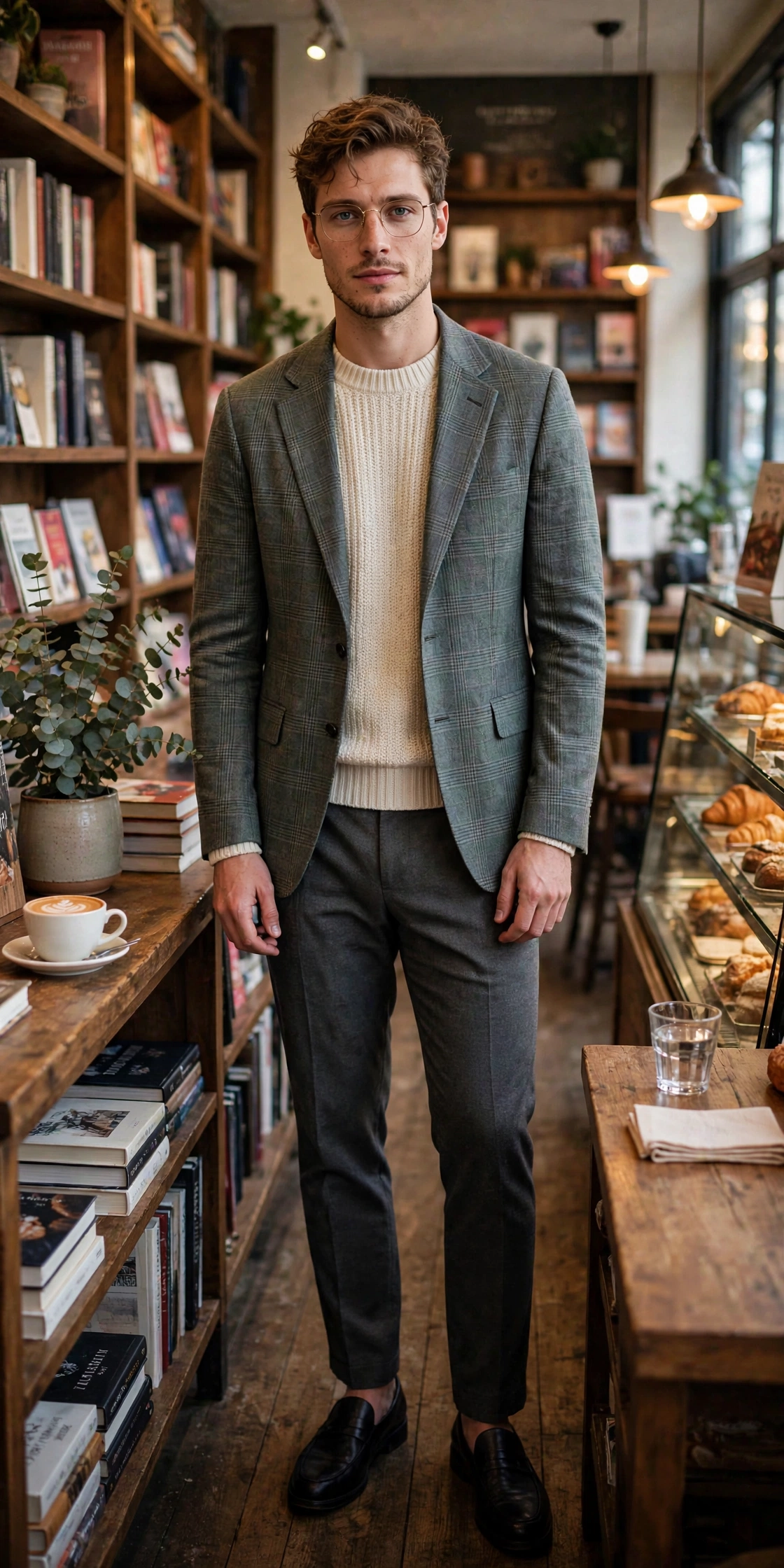
First, the office outfit: grey small-check blazer, white shirt, navy trousers, dark brown shoes. No tie, or a plain navy tie if the office is formal. This is the outfit to reach for when you are unsure. It reads as polished without trying hard.
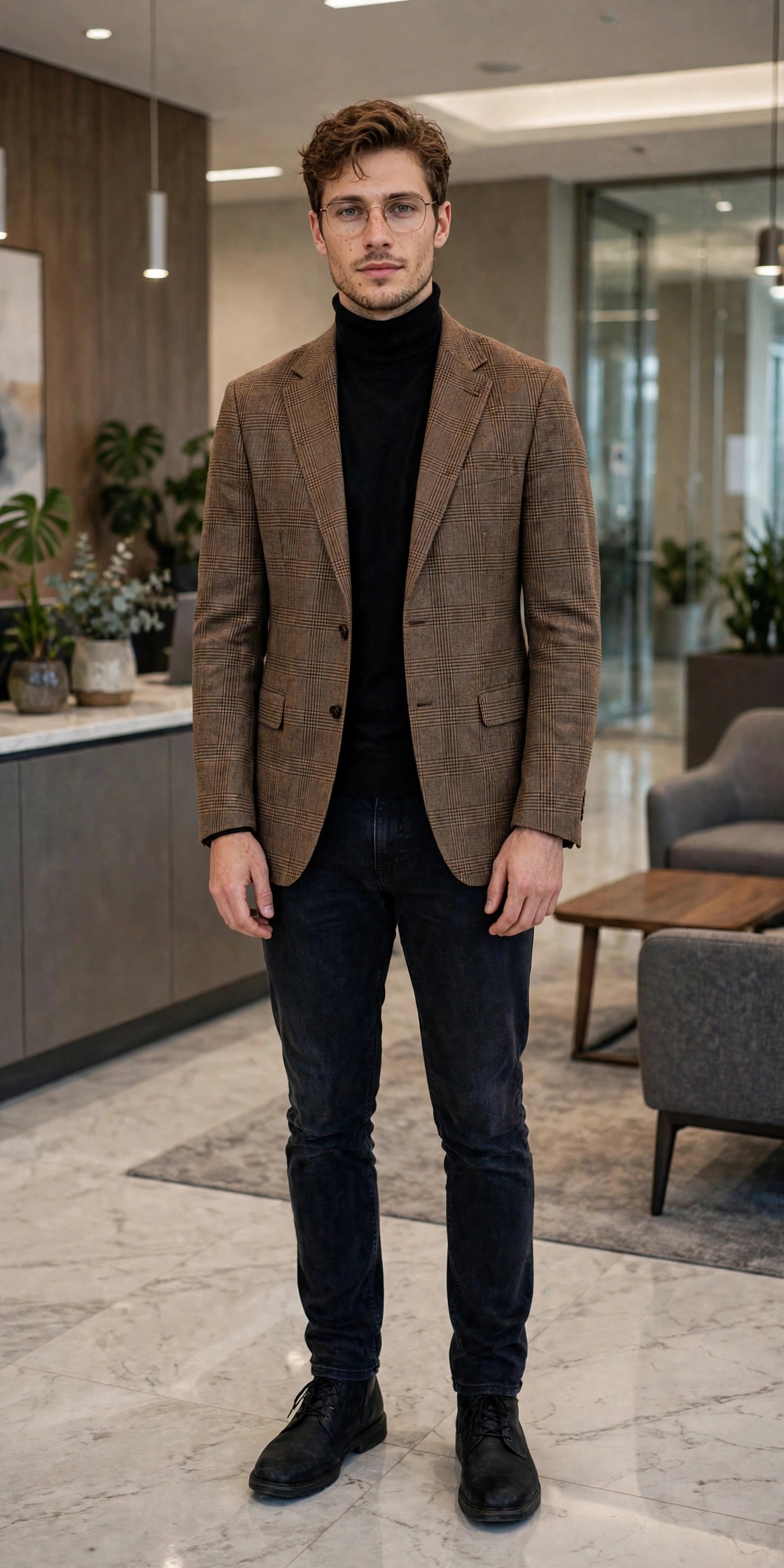
Second, the dinner outfit: navy plaid blazer, black turtleneck, charcoal trousers, black leather shoes. The dark base lets the plaid show without glare, and the turtleneck removes the need for a shirt and tie. This works for restaurants, evening events, and dates.
Third, the weekend outfit: brown windowpane or medium-check blazer, plain white or black T-shirt, dark jeans, clean white or brown leather sneakers. The blazer must be unstructured, with soft shoulders, or this will look like a suit jacket worn with jeans. If the blazer has strong padded shoulders and a stiff chest, keep it for smarter trousers instead.
Fourth, the cold-weather outfit: green-grey or brown plaid blazer, cream or charcoal fine knit sweater, dark trousers, brown boots. Add a plain dark overcoat on top if it is truly cold. The coat should be plain, because a patterned coat over a patterned blazer is too much. When you take the coat off indoors, the outfit underneath is already complete.
Daylight and mirror tests before you leave
Plaid looks different under shop lights than it does outside. Before you commit to a new blazer, or before an important event, do two quick tests. First, stand near a window in daylight and look at the blazer in a mirror. Daylight shows the true colours and the true scale of the check. A plaid that looked grey in the shop may show a strong blue or green line outside. That is not a flaw, but you need to know it before you pick trousers. Second, step back at least six feet from the mirror. From that distance, does the pattern settle into texture, or does it still jump out? If it still jumps, soften something: swap a bright shirt for a plain dark one, or swap light trousers for dark ones. Do not try to fix a loud blazer by adding more pattern elsewhere.
Photographs are a useful second check. Take a quick photo in daylight, full length, and look at it on your phone. Cameras pick up pattern clash and fit pulls that the eye misses in a mirror, because you see the outfit as a whole instead of in pieces. If the photo looks busy, simplify one item and photograph it again. One change at a time is enough to find the fix.
If-X-then-Y decisions
If your blazer has a large windowpane, then wear plain dark trousers, a plain dark shirt or turtleneck, and plain shoes. Let the blazer be the only statement.
If your blazer has a small check, then you can relax a little. A textured plain shirt, such as an Oxford cloth shirt, or suede shoes, will not compete, because the check is already quiet.
If you are shorter than average, then choose a smaller check and a shorter blazer length, and keep trousers and shoes in similar dark tones. A large check and a strong contrast at the waist will cut your height visually.
If you are taller or broader, then a medium or large check suits you, but watch the shoulder fit. A check that is too small on a broad frame can look like a texture rather than a pattern, which is fine, but it will not give you the plaid effect you paid for.
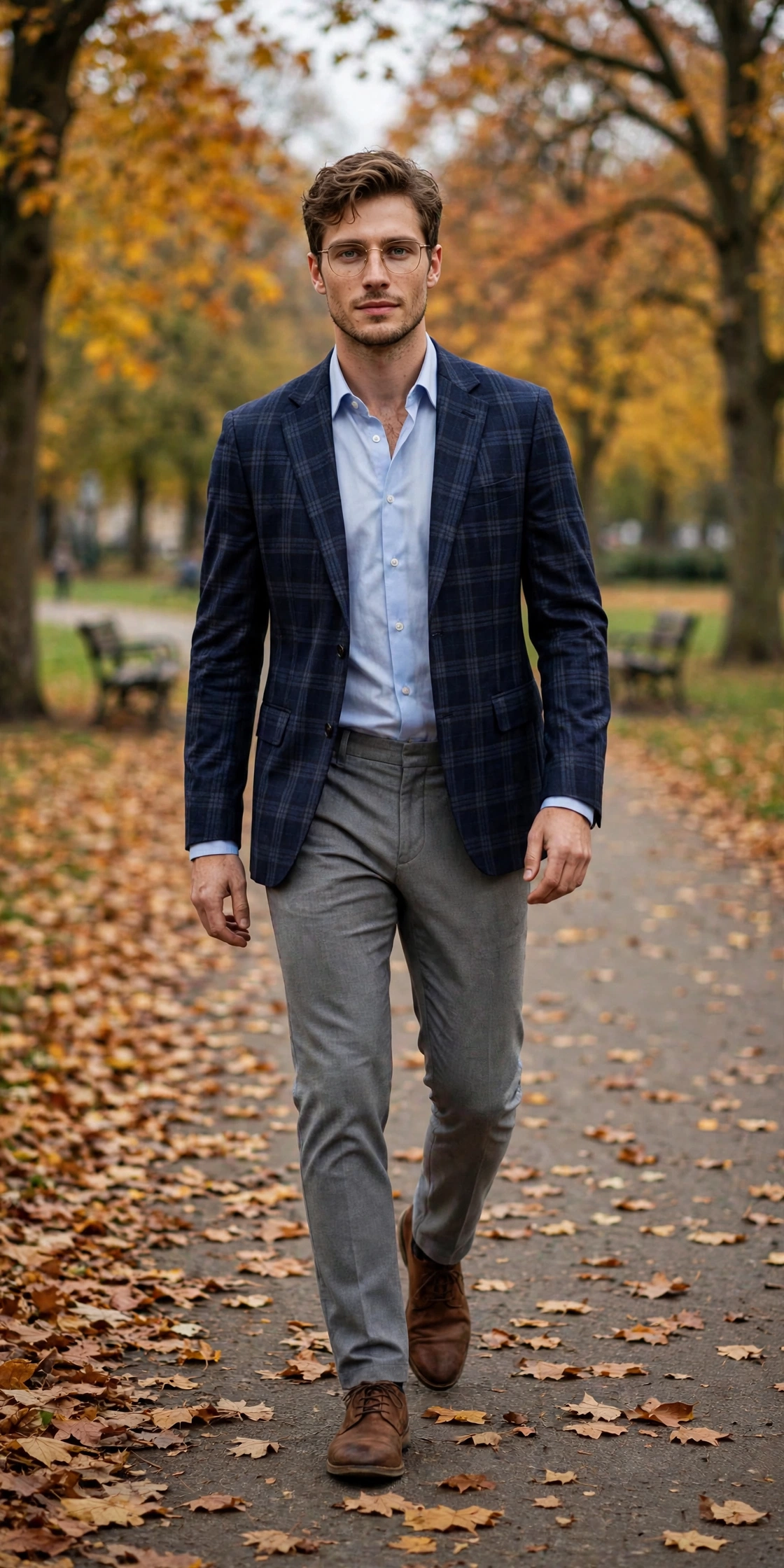
If the event is formal, then choose a dark plaid, a white shirt, dark trousers, and leather shoes, and skip the jeans and sneakers. If the event is casual, then choose an unstructured plaid, a plain T-shirt or knit, dark jeans, and clean sneakers.
If you already own a bright plaid, then build outfits around it in advance. Pick the trousers, shirt, and shoes that work, and keep them together in your mind as a set. That way you are not guessing on the day.
Care, storage, and making plaid last
Plaid blazers show wear in specific places. The elbows crease, the pocket edges fray, and the front can shine if pressed too hard. Brush the blazer after wearing it, especially if it is wool, and let it air for a day before hanging it back in a crowded wardrobe. Hang it on a wide, shaped hanger that supports the shoulders. A thin wire hanger will dent the shoulder and distort the check over time.
Do not wash a structured blazer at home unless the label clearly says you can. Dry cleaning is the usual route, but do not over-clean it. Cleaning after every wear wears the cloth faster than wearing it does. Spot-clean small marks, air it out, and clean it when it genuinely needs it, or at the end of a season.
When you press or steam a plaid blazer, use low heat and a pressing cloth, and never press hard on the front. Hard pressing flattens the check and can create a shine that makes the pattern look cheap. Steaming is gentler and usually enough to remove wrinkles from wool. If the blazer has a stain, deal with it promptly and tell the cleaner what it is. Old stains set, and a stained plaid is harder to wear than a stained solid because the eye is already drawn to the pattern.
Common mistakes, and how to avoid them
Wearing a plaid blazer with plaid trousers is the most common mistake, unless the two pieces are a matched suit cut from the same cloth. A near-match is worse than a clear contrast, because it looks like a mistake rather than a choice. If you want a plaid suit, buy it as a suit.
Wearing a striped shirt with a plaid blazer is the second mistake. Stripes and checks compete, and the result is visual noise. The same goes for a checked tie or a checked pocket square with a checked blazer. One pattern is enough.
Buying a blazer that is too tight because it looks slim in the mirror is the third mistake. Plaid shows tightness as an X pull at the button and as bent lines across the chest. A blazer that fits with a little room looks slimmer in real life than a tight one that pulls, because the lines stay straight.
Wearing a formal, padded-shoulder plaid blazer with jeans and trainers is the fourth mistake. The top half says boardroom, the bottom half says weekend, and the plaid makes the clash more obvious. Match the structure of the blazer to the rest of the outfit: soft blazer for casual, structured blazer for smart.
Finally, keeping a plaid blazer you do not like because it was expensive is a mistake of a different kind. If the scale is wrong for you, or the colours do not suit you, no styling trick will fix it every time. Sell it, swap it, or pass it on, and buy a quieter check you will actually reach for.
A simple buying checklist
Use this list before you pay. One, does the check settle into texture from six feet away, or does it still shout? Two, do the lines match reasonably at the shoulders and the front? Three, do the shoulders sit at your shoulder bones? Four, does the front lie flat when buttoned, without an X pull? Five, do the sleeves show a little shirt cuff? Six, do you already own plain trousers, a plain shirt, and plain shoes that work with it? If you answer yes to all six, you have a blazer you will wear. If you answer no to more than one, keep looking. A plaid blazer should earn its place by being easy to wear, not by being interesting on the hanger.
Mens plaid blazers reward restraint. Pick a scale that suits your frame, colours that suit your wardrobe, and a fit that keeps the lines straight. Keep everything else plain. Do the daylight test, photograph the outfit once, and trust the mirror from six feet away. Done well, plaid does not make you look loud. It makes a plain outfit look considered, and that is exactly why it has lasted.
Frequently asked questions
Can I wear a plaid blazer to the office?
Yes, if the check is small or medium and the colours are muted, such as grey, navy, or brown. Pair it with a plain shirt, plain dark trousers, and plain leather shoes. Skip a patterned tie and a patterned pocket square. If your office is very formal, choose a dark, small-check blazer and a white shirt, and check whether blazers without a matching suit are accepted before an important meeting.
What shirt should I wear with a plaid blazer?
A plain shirt is the safest choice. White works with almost every plaid, light blue works with navy and grey plaids, and black or charcoal works with dark plaids for evenings. A plain turtleneck or fine knit sweater also works in cold weather. Avoid striped shirts and checked shirts, because they compete with the blazer pattern.
Can I wear a plaid blazer with jeans?
Yes, if the blazer is unstructured with soft shoulders and the jeans are dark, clean, and straight. Pair them with a plain T-shirt or knit and clean sneakers or leather shoes. Do not wear a stiff, padded-shoulder blazer with jeans, and do not wear faded, ripped, or heavily washed jeans with any blazer if you want the outfit to look smart.
What is the difference between plaid, check, and windowpane?
Plaid and check are often used for the same thing, a pattern of crossed lines forming squares. Windowpane is a specific type of check with wide, widely spaced lines that form large open squares, like a window frame. In practice, small checks are the quietest, medium checks are the classic middle ground, and windowpane is the boldest and needs the plainest outfit around it.
How do I keep a plaid blazer from looking too loud?
Keep one pattern per outfit, choose muted colours, and let the blazer be the only statement. Wear plain dark trousers, a plain shirt, and plain shoes. Step back six feet from a mirror in daylight. If the pattern still jumps out, darken the shirt or trousers. Do not add more pattern to balance a loud blazer, because that usually makes the outfit busier.
Should a plaid blazer match my trousers?
No, unless it is a matched suit cut from the same cloth. For a separate blazer, trousers should contrast clearly in a plain colour, usually navy, charcoal, or dark denim. A near-match in a different plaid looks like a mistake. Clear contrast looks deliberate and is much easier to get right.