
A midi dress can be one of the easiest work outfits you own. It is a complete outfit in one piece, it looks polished without much effort, and it works across seasons with simple layering. The challenge is choosing the right one. Length, fit, fabric, neckline, and sleeve style all affect whether a midi dress feels professional, comfortable, and appropriate for your workplace.
This guide answers the question of how to choose midi dress for work USA shoppers ask most often: which length is actually work-appropriate, which fits flatter without being restrictive, which fabrics hold up through a long day, and how to style the same dress for different offices and seasons. You will find measurement tips, fit checklists, fabric comparisons, outfit formulas, and common mistakes to avoid, so you can shop with confidence instead of guessing.
The Short Answer First
If you need a quick rule, here it is. For most offices in the United States, choose a midi dress that ends between just below the knee and mid-calf, fits comfortably at the shoulders and waist without pulling, uses an opaque, structured fabric such as ponte, crepe, or a cotton blend, and has a neckline and sleeve style that match your workplace dress code. Pair it with polished shoes, a structured bag, and a blazer or cardigan for meetings or cooler offices. That combination is professional, comfortable, and easy to repeat with different colors and accessories.
The rest of this guide explains why that rule works, and how to adjust it for your body, your office, and your climate.
What Counts as a Midi Dress?
A midi dress is generally defined by length: it falls below the knee and above the ankle. Within that range there is real variation. A dress that ends just below the knee reads differently from one that ends at mid-calf, and both read differently from one that ends just above the ankle. All three can be called midi, but they suit different heights, shoe choices, and workplace cultures.
- Just below the knee: The most versatile work length for many people. It pairs easily with flats, loafers, and heels, and it works well for shorter wearers who want leg length to show.
- Mid-calf: Often the most polished and modest option. It pairs beautifully with pointed flats, block heels, and boots in cooler months. It can shorten the leg visually if the hem cuts at the widest part of the calf, so fit and shoe choice matter.
- Lower calf, above the ankle: Elegant and dramatic, but harder to style for active workdays. It works best with a defined waist and a shoe that does not compete with the hem.
When you try a dress on, check the length while standing, walking, and sitting. A dress that looks perfect standing up may ride up when you sit at a desk. Ideally, the hem should still fall below the knee when seated, especially if your workplace expects a conservative length. Bring the shoes you will wear most often to the fitting, because heel height changes where the hem appears to fall.
Start With Your Workplace Dress Code
Workplace culture in the USA varies widely. A law firm, a school, a tech startup, a hospital office, and a retail headquarters may all use the word professional, but they mean different things in practice. Before you shop, be honest about your daily environment.
Ask yourself: Do colleagues wear suits, business-casual separates, or relaxed casual clothes? Are sleeveless dresses common, or do most people cover their shoulders? Are bright colors and prints welcome, or is the palette mostly neutral? Do you spend the day at a desk, on your feet, meeting clients, or moving between buildings?
A good test is to look at what you already wear to work and feel confident in. If you normally wear tailored trousers and blouses, a structured midi dress in a solid color will fit right in. If your office is more relaxed, a soft knit midi dress with a cardigan may be perfect. If you meet clients, a more structured fabric and a blazer will help the dress read as intentional and polished.
When in doubt, choose the slightly more polished option. A dress that is a little more structured can be softened with a cardigan and flat shoes. A dress that is too casual — very thin jersey, a beachy print, or a hem that moves too much when you walk — is harder to make look professional.
Fit: The Details That Make or Break a Work Midi Dress
Fit matters more than trend for work dresses, because you will sit, walk, bend, reach, and possibly commute in the same dress for eight or more hours. Comfort is not optional.
Shoulders and Bodice
The shoulder seam should sit at the natural edge of your shoulder. If it droops, the dress will look oversized and the neckline may shift. If it pulls inward, the bodice will feel tight across the back and chest. For a fitted bodice, check that there is no gaping at the neckline when you lean forward, and no horizontal wrinkles across the bust that signal the dress is too tight. For a looser bodice, check that it does not look boxy or shapeless; a defined waist, a belt, or a wrap style can add shape without tightness.
Waist and Hips
Many work midi dresses use one of four waist treatments: a natural waist seam, an empire waist just below the bust, a wrap waist that ties at the side or front, or no defined waist at all in a shift or A-line shape. Each suits different preferences.
A natural waist seam is classic and works well for offices because it creates a clear, polished line. A wrap waist is adjustable, which is helpful if your weight fluctuates or you prefer a customizable fit, but check that the wrap does not open when you sit or walk. An A-line shape that skims from the waist or bust outward is comfortable and forgiving, and it pairs well with flats and heels alike. A straight shift shape can look modern and clean, but it needs to fit well at the hips to avoid pulling when you sit.
Try sitting in the dress for at least a minute when you try it on. Stand up, sit down, cross your legs if you normally do, and walk a few steps. The dress should not ride up excessively, twist at the waist, or require constant adjustment.
Sleeves and Necklines for Work
Sleeve choice affects both comfort and dress-code fit. Short sleeves are practical for warm offices and summer months. Three-quarter sleeves are flattering on many people and work well in transitional weather. Long sleeves add polish and warmth for winter. Sleeveless dresses can be perfectly professional in many offices, especially when layered with a blazer or cardigan, but check your workplace norms and consider whether you want a layer for air-conditioned rooms.
Neckline choice follows the same logic. A crew neck, V-neck, scoop neck, or modest boat neck all work for offices, as long as the depth is comfortable when you bend or lean forward. A very deep V-neck or a neckline that gaps may need a camisole underneath or a different size. A higher neckline, such as a mock neck, can look very polished, but make sure it does not feel restrictive around the neck, especially if you wear it all day.
Measurements That Help You Shop Online
Because sizes vary between brands, your measurements are more reliable than a single size label. Measure your bust at the fullest point, your natural waist, your hips at the fullest point, and your shoulder width if the brand provides it. For midi length, also note your height and where you prefer the hem to fall. A dress described as midi on a tall model may fall above the knee on a taller shopper, or near the ankle on a shorter shopper, so check the product’s length measurement when it is listed, and read reviews for comments on length.
A practical online checklist:
- Compare your bust, waist, and hip measurements to the size chart, not just one measurement.
- If you fall between sizes, consider which area matters most for that dress style. For a fitted bodice, bust fit often matters most. For a fitted skirt, hip fit matters most.
- Check whether the dress has stretch. Ponte and jersey offer more forgiveness than woven crepe or cotton poplin.
- Confirm the return policy before ordering, and try the dress on at home with work shoes and the undergarments you will wear with it.
Fabric Guide for Work Midi Dresses
Fabric determines how a dress looks at 9 a.m. versus 5 p.m., how it feels in a warm office, and how much care it needs. Here is a clear comparison for workwear.
| Fabric | Best for | Watch out for |
|---|---|---|
| Ponte knit | Structured, comfortable, wrinkle-resistant work dresses | Can be warm in high summer; choose a lighter weight for warm months |
| Crepe | Polished drape, good for meetings and client days | Some crepes need gentle washing or dry cleaning; check the label |
| Cotton and cotton blends | Breathable, easy-care everyday office dresses | Pure cotton can wrinkle; blends often hold shape better |
| Jersey knit | Soft, comfortable, easy to wear all day | Thin jersey can cling and look too casual; choose a heavier, structured jersey for work |
| Wool blends | Winter work dresses with warmth and structure | Care requirements vary; many need dry cleaning or gentle washing |
| Linen blends | Warm-weather offices with a relaxed but neat dress code | Linen wrinkles naturally; blends reduce wrinkling while keeping breathability |
| Scuba or neoprene-style knits | Very structured, modern silhouettes | Can be warm and less breathable; best for cooler offices or shorter wear |
For a first work midi dress, ponte or crepe in a solid neutral color is often the safest choice. Both hold their shape, resist wrinkling through a commute and a workday, and pair easily with blazers and cardigans. Once you have a reliable neutral dress, you can add a second dress in a color, print, or softer fabric that suits your office culture.
Also check opacity. Hold the dress up to light or try it on in bright light. If you can see undergarments or skin through the fabric, you will need a slip or a different dress. Work dresses should be opaque without extra layers, unless the design intentionally includes a lining.
Choosing Color and Print for the Office
Solid colors are the easiest starting point for work midi dresses. Navy, black, charcoal, burgundy, forest green, and deep teal all read as professional and pair with many shoes, bags, and jackets. A solid dress also makes accessorizing simple: change the scarf, shoes, or jacket, and the same dress looks different on different days.
Prints can work beautifully for work, if they are chosen carefully. Small florals, subtle geometrics, pin dots, and classic stripes tend to read as polished. Large, high-contrast prints, very bright neon colors, and beach-style patterns are harder to style for conservative offices. A useful rule is one print per outfit. If the dress is printed, keep shoes, bag, and jacket solid. If the dress is solid, a printed scarf or shoe can add personality without overwhelming the outfit.
Seasonal color can also guide you. Darker neutrals and jewel tones suit autumn and winter. Lighter neutrals, soft blues, sage, and muted pastels suit spring and summer, while still looking professional. You do not need to follow seasonal color rules strictly, but they are a helpful starting point if you feel stuck.
Styling a Midi Dress for Work: Outfit Formulas
The Classic Office Formula
Midi dress in a solid neutral + blazer + pointed flats or low block heels + structured tote. This works for meetings, presentations, and client-facing days. Choose a blazer that ends at or just below the waist of the dress to keep proportions clean. If the dress has a defined waist, a shorter blazer preserves that line. If the dress is A-line, a slightly longer blazer can balance the skirt volume.
The Comfortable Desk-Day Formula
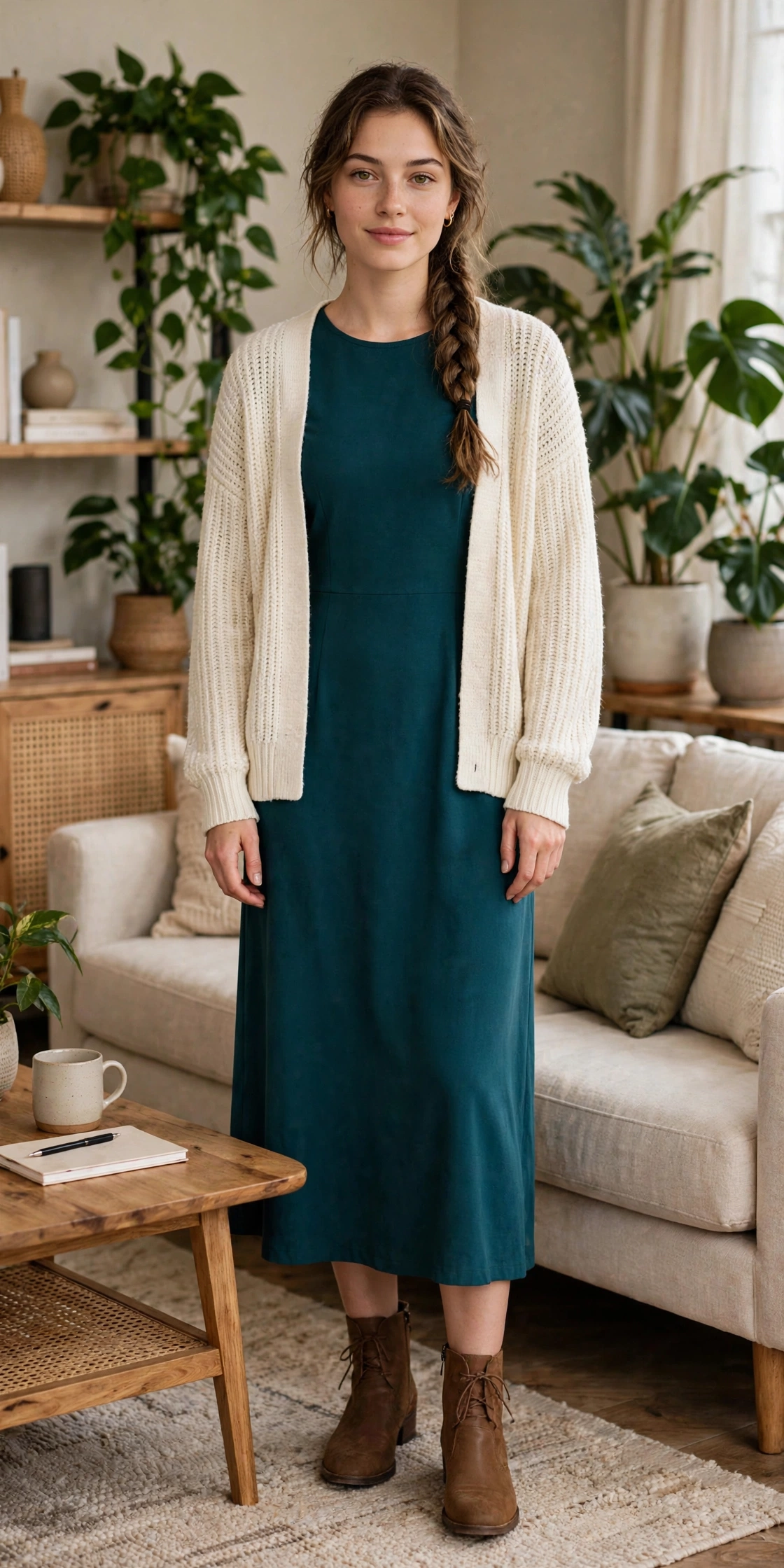
Ponte or jersey midi dress + open cardigan + loafers or supportive flats + crossbody or tote bag. This is ideal for long desk days, because nothing digs in, the cardigan adds warmth for air conditioning, and the shoes are easy to walk in. Choose a cardigan that ends above or below the dress hem in a way that does not cut the silhouette awkwardly; hip-length or longer cardigans usually work best with midi lengths.
The Warm-Weather Formula
Short-sleeve or sleeveless midi dress + light cardigan or blazer kept nearby + sandals that are polished, not beach-style, or low wedges. In warm climates, breathable cotton or linen-blend dresses are more comfortable than heavy ponte. Keep a light layer in your bag for air-conditioned offices, and choose shoes with a closed toe or a polished leather sandal if your office expects it.
The Cold-Weather Formula
Long-sleeve midi dress + tights + boots + wool coat. Mid-calf dresses pair especially well with knee-high or ankle boots, because the boot fills the gap between hem and shoe cleanly. Choose opaque tights in black, navy, or charcoal for a polished finish, and make sure the dress hem does not catch on the boot top when you walk. A structured coat that ends at or below the hem can look elegant, while a shorter coat can work if proportions are balanced.
For more outfit building ideas, the Women category and guides on Tops and Blouses can help you think about layering, because the same blazer and cardigan principles apply to dresses and separates alike.

Shoes, Bags, and Accessories That Work With Midi Lengths
Shoes change how a midi dress looks more than almost any other choice. Pointed flats elongate the leg and work with nearly every midi length. Loafers add a polished, slightly relaxed feel and are excellent for walking and commuting. Low block heels offer height without the discomfort of stilettos and pair well with mid-calf lengths. Ankle boots work best when the hem clears the boot or the boot sits neatly under a fuller skirt; avoid a hem that ends exactly at the boot top, which can look awkward.
Bags should be proportional to the outfit. A medium structured tote works for most workdays because it carries a laptop, notebook, and essentials without overwhelming a dress silhouette. A small crossbody is better for lighter days or evening events after work. Avoid very large, slouchy bags with a very structured dress, because the contrast can make the outfit look unbalanced.
Accessories should be simple and intentional. A delicate necklace, small earrings, a classic watch, and a leather belt (if the dress has belt loops or a waist that benefits from definition) are usually enough. A scarf can add color and warmth, but make sure it does not compete with a printed dress. If you wear a statement piece, let it be the single focal point and keep everything else quiet.
Common Mistakes When Choosing a Work Midi Dress
Choosing length by the model photo alone.
Models vary in height, and photos can be misleading. Always check the listed length, your own height, and reviews, and try the dress on with your work shoes.
Ignoring the sit test.
A dress that looks perfect standing can ride up, gap, or twist when seated. Sit, walk, and reach before deciding.
Buying a dress that needs constant adjustment.
If you are pulling the neckline up, tugging the hem down, or adjusting a wrap tie all day, the dress is not the right fit, no matter how beautiful it looks in the mirror.
Choosing fabric that wrinkles badly for a long day.
A dress that looks crisp at home but creased by lunchtime will not feel professional. Ponte, crepe, and heavier jerseys are safer for long workdays than thin linen or lightweight cotton, unless your office is very relaxed.
Forgetting undergarments.
The right bra, slip, and seamless underwear can transform how a dress fits and looks. Try the dress with the undergarments you will actually wear, not just the ones you happen to have on in the store.
Over-accessorizing a printed dress.
Prints already provide visual interest. Pair them with solid shoes, a solid bag, and minimal jewelry for a clean, professional result.
Care and Longevity
Work dresses earn their value through repeated wear, so care matters. Follow the care label, but a few general habits help. Wash dresses inside out on a cool, gentle cycle when machine washing is allowed, and avoid high dryer heat, which can shrink fabric and fade color. Hang dresses on sturdy, shaped hangers that support the shoulders, and use garment bags for wool or delicate dresses in storage. Steam or press as needed, especially for crepe and cotton dresses that wrinkle in transit.
Rotate your dresses rather than wearing the same one several days in a row. Rotation reduces wear, gives fabric time to recover, and makes your wardrobe feel larger because you are not relying on a single favorite. If a dress is a true favorite, consider buying it in a second color only after you have worn the first one enough to confirm fit, fabric, and comfort through a full workday.
Frequently Asked Questions
What length midi dress is most appropriate for work?
For most offices, just below the knee to mid-calf is the safest range. It reads as professional, stays comfortable when seated, and pairs with flats, heels, and boots. Choose within that range based on your height, your office culture, and the shoes you prefer.
Can I wear a sleeveless midi dress to work?
In many offices, yes, especially with a blazer or cardigan. Check your workplace norms first. If sleeveless dresses are uncommon in your office, choose short sleeves or three-quarter sleeves, or keep a layer on throughout the day.
Are midi dresses suitable for petite or tall shoppers?
Yes, with attention to proportion. Petite shoppers often prefer just-below-the-knee lengths and defined waists to avoid being overwhelmed by fabric. Tall shoppers can wear mid-calf and lower-calf lengths beautifully, but should check that the waist seam sits at the natural waist rather than above it. In both cases, the listed garment length and reviews are more helpful than the size label alone.
How many work midi dresses do I need?
Start with one reliable neutral dress that fits perfectly and suits your office. Add a second in a different color or print once you know the first works through a full day. Two to four well-chosen work dresses, rotated with different jackets, shoes, and accessories, can cover many workweeks without feeling repetitive.
What should I wear under a midi dress for work?
Choose undergarments that are smooth, supportive, and invisible under the dress fabric. A well-fitting bra, seamless underwear, and, if needed, a slip for sheer or clingy fabrics will improve both comfort and appearance. Avoid visible straps or lines that distract from the dress silhouette.
Quick Checklist Before You Buy
- Hem falls between just below the knee and mid-calf when standing and seated.
- Shoulders sit at the natural shoulder edge; bodice does not gap or pull.
- Waist treatment suits your comfort and stays in place when you sit and walk.
- Fabric is opaque, structured enough for work, and manageable to care for.
- Neckline and sleeves match your workplace dress code.
- Shoes you will wear with it make the proportions look balanced.
- You can name at least three work outfits using this dress with jackets, shoes, or accessories you already own.
A good work midi dress should make mornings easier, not harder. When fit, length, fabric, and workplace culture align, one dress can carry you through meetings, desk work, commutes, and after-work plans with confidence. Start with a solid neutral, test it through a full day, and build from there.
Browse more ideas in the Dresses category.
To recap, learning how to choose midi dress for work USA shoppers can use is simple: start with fit, check length while seated, choose a fabric that holds up all day, and then browse the Dresses category for a style that fits your office. Use the checklist above before you buy.